
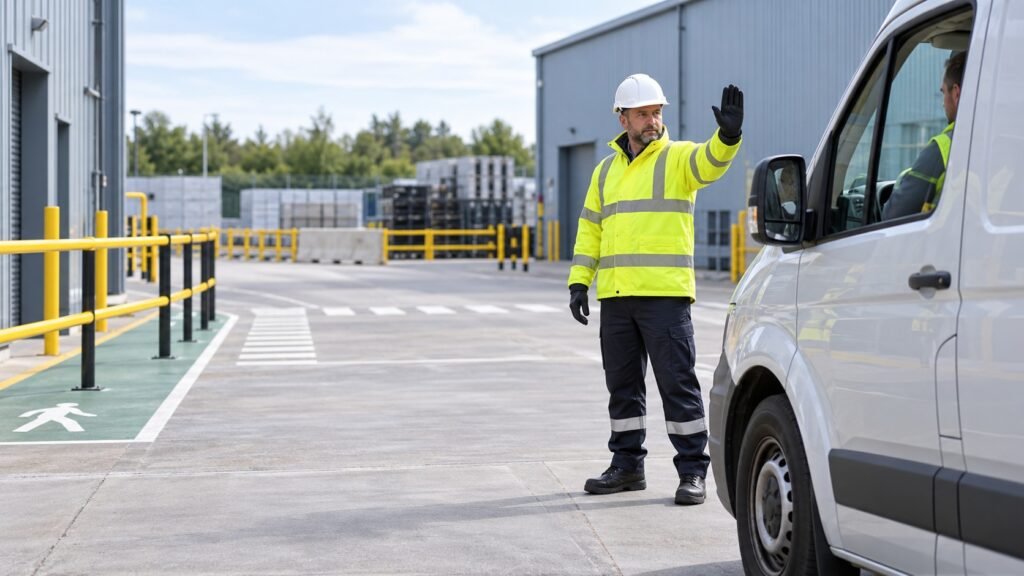
This awareness course explains how standard hand signals support safe, unambiguous communication during hazardous workplace manoeuvres, particularly where vehicle movement or restricted visibility creates risk.
What you will cover
- Why hand signals are used and where they sit in the hierarchy of control.
- Roles, competence, authorisation and pre-movement briefing.
- Safe positioning, exclusion zones and maintaining visibility.
- General, vertical, horizontal, distance and danger signals.
- Driver–signaller communication, stop-work rules and loss of contact.
- Communication aids, changing conditions and safe close-out.
Course structure
Complete eight lessons followed by a course-level 12-question final assessment. The pass mark is 80% (at least 10 correct), and retakes are permitted.
Competence boundary: this course provides awareness only. It does not qualify or authorise a learner to act as a banksman, traffic marshal or lifting signaller. Employers must avoid or reduce hazardous manoeuvres where reasonably practicable, appoint trained and competent people where signalling is necessary, and provide task-, site- and equipment-specific instruction and supervision.
Course Content
1. Why hand signals are used
You don't currently have access to this content
2. Roles, competence and the pre-movement brief
You don't currently have access to this content
3. Safe position, visibility and exclusion zones
You don't currently have access to this content
4. General and emergency signals
You don't currently have access to this content
5. Vertical, horizontal and distance signals
You don't currently have access to this content
6. Controlling the movement
You don't currently have access to this content
7. Radios, poor conditions and communication failure
You don't currently have access to this content
8. Safe close-out and personal duties
You don't currently have access to this content
Final Quiz
Hand Signals – Final Assessment
You don't currently have access to this content

 Certify Pro